Research
What If the Robot Hand Didn't Need the Rest of the Robot?
ETH Zurich researchers taught a five-fingered robotic hand to crawl, recover from falls and push objects using reinforcement learning.
A Hand That Can Walk on Its Own
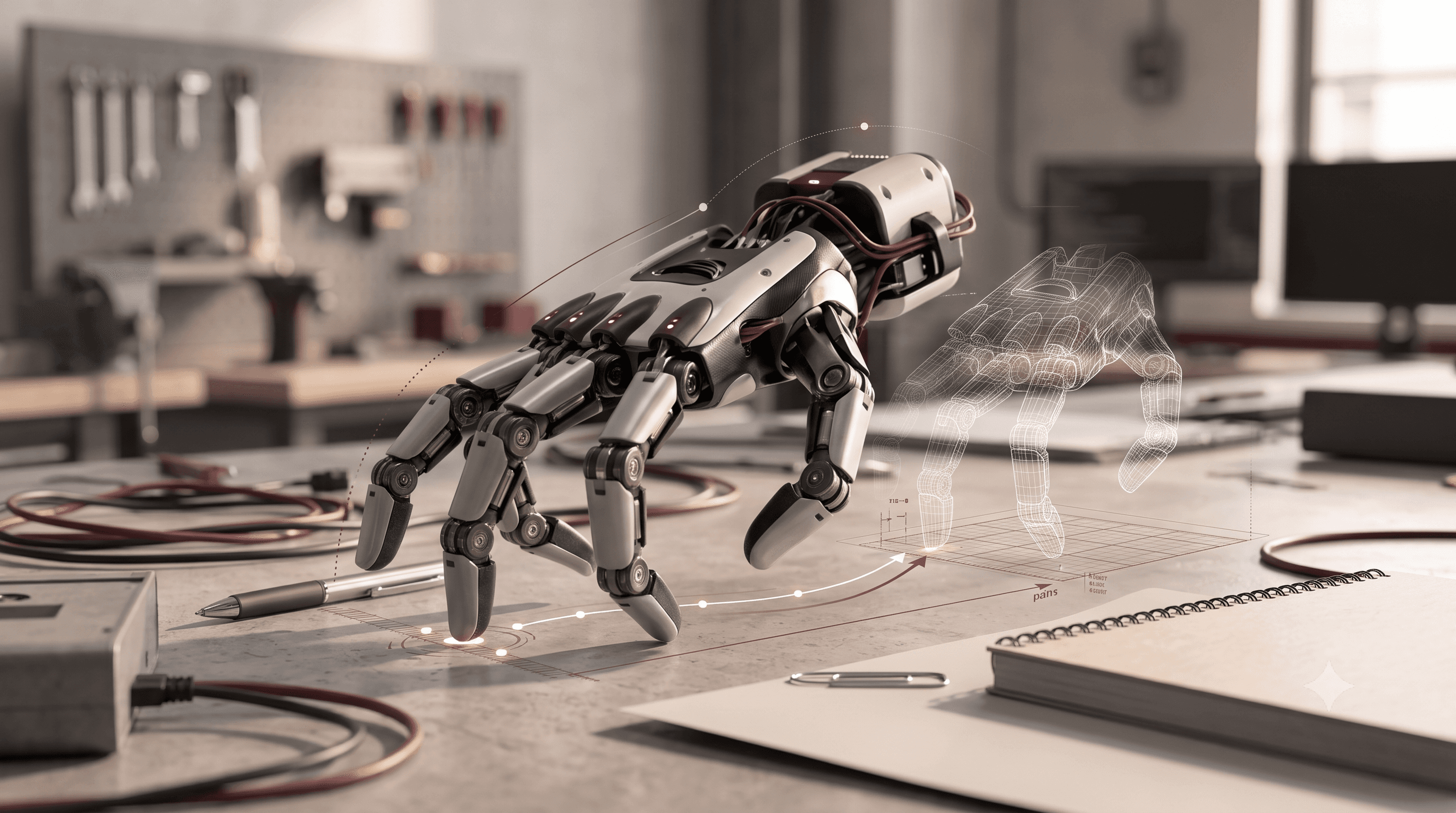
Most robotic hands are designed to do one thing: manipulate objects while attached to a robotic arm. Researchers at ETH Zurich challenged that assumption by turning an anthropomorphic robotic hand into a self-contained mobile machine.
Their project, Fingers as Legs, uses an existing five-fingered hand with 20 powered joints. A compact module supplies onboard power and computing, bringing the complete platform to approximately 818 grams. Instead of adding wheels or building a separate set of legs, the researchers made the hand use its own fingers for locomotion.
The challenge is that those fingers must do several jobs simultaneously. They need to support the hand's weight, generate movement, and maintain enough stability for the body to avoid tipping over. The thumb also differs from the other fingers in its orientation, while each finger has a different length. That makes coordinating movement much less straightforward than controlling a conventional four-legged robot.
How Reinforcement Learning Teaches Fingers to Walk
Rather than programming every step individually, the team trained the hand using reinforcement learning in a simulator calibrated with measurements from the physical hardware.
The learning algorithm lets the hand try different movements and improve its strategy using reward feedback. The researchers guide the behavior through objectives such as maintaining fingertip positions and coordinating the timing of each step, while the learned policy figures out how to move the fingers to satisfy those objectives.
The system uses Proximal Policy Optimization (PPO), a reinforcement learning algorithm, with an asymmetric actor-critic setup. During training, the critic can use additional information available in simulation to evaluate how promising an action is. The actor learns the movement policy that will eventually run on the physical hand, where that extra simulator information is unavailable.
This distinction matters because the finished robot cannot rely on the simulator to tell it what to do. After training, the learned policy runs onboard and uses the hand's available sensor information to generate joint adjustments. The result is a hand that can crawl and steer without being tethered to an external computer.
If you're curious about the broader approach, our guide to how robots learn without being programmed explains how reinforcement learning fits into modern robot training.
Walking Is Only the Beginning
The interesting part of the research is that locomotion is not the hand's only learned behavior. The team demonstrated untethered crawling across 14 indoor and outdoor surfaces, including grass, gravel, carpet, tile, asphalt, and concrete. It also demonstrated recovery after falling, pressing keyboard keys, and pushing a cube toward a target while supporting its own weight.
These tasks require different skills. Crawling means coordinating the fingers to move the body. Recovering from a fall requires a different strategy to return to a stable position. Pushing an object adds another challenge: the hand must maintain its own balance while applying force to something else.
The researchers used task-specific policies rather than one universal policy for every behavior. That is an important detail: the demonstration shows that one piece of hardware can support several learned capabilities, not that it can automatically perform any task without additional training.
The work also connects to a larger challenge in robotics: dexterous hands are difficult to control because so many joints interact through contact with the environment. Our article on why robot hands are so hard explores that problem in more detail.
What This Could Mean for Robot Design
A hand that moves independently could eventually help robotic systems reach places where a full arm or larger mobile platform would struggle. A compact device might crawl through a confined space, position itself near an object, and then use the same fingers to interact with it. Those are potential applications, not capabilities established by this demonstration.
There is still work to do before this becomes a practical general-purpose robot. The current behaviors rely on task-specific policies, and the demonstrated platform does not establish that a hand can navigate arbitrary environments or reliably perform complex manipulation in uncontrolled settings.
Still, the central idea is worth paying attention to. Robotics often advances by adding new hardware: another sensor, another actuator, another mechanism. This project explores a different route by changing what existing hardware is capable of doing through learning.
Instead of designing a separate machine for every task, researchers could increasingly look for new ways to reuse the hardware they already have. Sometimes, a robot's next capability may come from giving its existing body a completely different job.
FAQ
How can a robotic hand walk without an arm?
The hand uses its five fingers to support its weight and move its body. Onboard power and computing allow it to operate as a self-contained platform rather than relying on a connected robotic arm.
How did ETH Zurich teach the hand to walk?
The researchers trained a reinforcement learning policy in a simulator calibrated using hardware measurements. The learned policy was then deployed on the physical hand to control its finger movements.
Can the robotic hand do more than crawl?
Yes. The team demonstrated steering, recovery after falls, keyboard presses, and pushing an object toward a target. Different behaviors use task-specific learned policies.
Could this design be used in real-world robotics?
Potentially. A compact, self-supported hand could be useful in confined spaces or situations requiring both movement and manipulation. However, broader navigation and reliable performance across unfamiliar environments remain open challenges.