
Research
5 Ways Robots Learn Without Being Programmed
Robots no longer need every move coded by hand. Here are 5 ways robots learn instead, from demonstrations and reinforcement learning to human videos and VLAs.
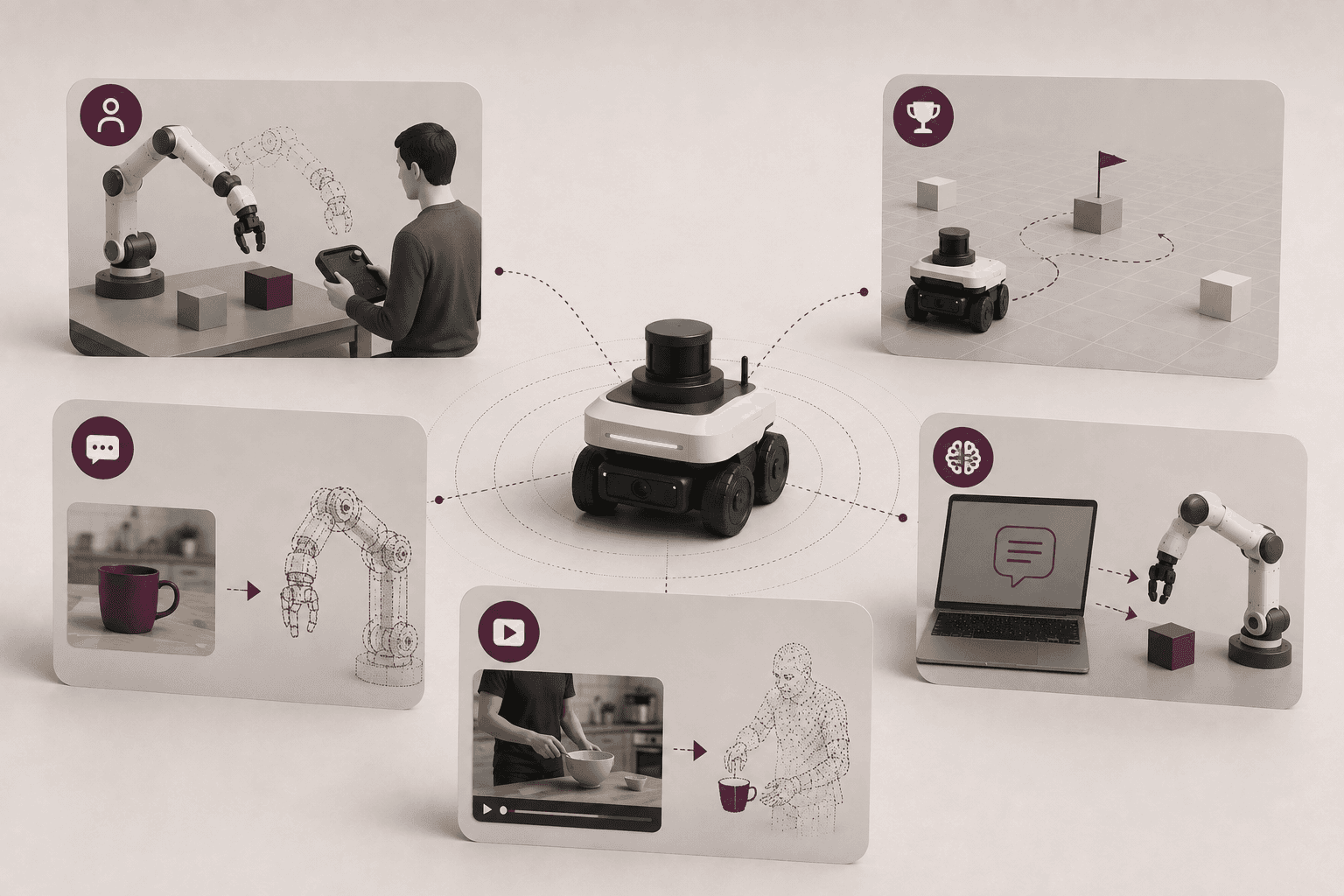
You no longer have to script a robot's every movement. You can show it what to do, give it a goal, or just tell it what you want, and let it work out the rest.
You don't have to program a robot's every movement anymore. Understanding how robots learn without programming comes down to a shift in approach: instead of writing out each motion, engineers show the robot what to do, give it a goal, or describe the task in plain language. Here are five ways robots learn to act on their own.
1. Learning from demonstrations
The most intuitive method is to simply show the robot. A person performs a task, often by teleoperating the robot directly, the robot records that demonstration, and a model learns how those actions produce the result. Do this enough times and the robot can reproduce the task on its own.
This approach, sometimes called imitation learning, is behind a lot of recent manipulation progress. Low-cost platforms like the ALOHA dual-arm system exist largely to make collecting these human demonstrations easy. The appeal is obvious: showing a robot a task is far more natural than coding it.
2. Reinforcement learning
But what if you don't show the robot the right answer? That's where reinforcement learning comes in. You give the robot a goal, let it try many different actions, and reward the ones that move it closer to success. Over enough attempts, it discovers a working behavior on its own, without ever being told the exact motions.
This is how a lot of robot locomotion and control is learned. We walked through a hands-on example in training a Franka Panda to push a cube with reinforcement learning, where the arm figures out the task purely from trial and reward.
3. Learning in simulation
Those trial-and-error attempts don't have to happen on real hardware, and usually they shouldn't. In simulation, a robot can practice thousands of times without any risk to the machine. It can fail, reset, and try again in seconds, and many virtual copies can train in parallel, which makes learning dramatically faster and cheaper.
This is why almost every robot trains in simulation first. The catch is the sim-to-real gap, the small differences between simulation and reality that a learned behavior has to survive, but the speed and safety make it worth it for the bulk of training.
4. Learning from human videos
Robots can learn from more than just robot data. They can also learn by watching us. Researchers are increasingly using ordinary human videos, people cooking, opening doors, picking things up, to extract information about objects, actions, and how tasks get done.
The appeal here is scale. There is a vast amount of video of humans doing things, far more than anyone could ever collect on robots directly, which is why approaches like learning manipulation from human video have drawn so much attention. Tapping into it is a way to teach robots about the physical world without running a robot for every example, and it's a fast-moving area of embodied AI research.
5. Vision-language-action models
The newest approach combines much of the above with models that understand language. Vision-language-action (VLA) models connect three things: what a robot sees, what it's told, and what it should do. The model takes in the camera view and an instruction, and outputs the actions to carry it out.
The result is that instead of writing a routine for every task, you can give the robot a plain-language instruction, like "pick up the red cup", and let the model translate it into motion. VLA models are among the most important AI models changing robotics right now, and the basis of systems like Google DeepMind's Gemini Robotics 2.
Where all five approaches are heading?
These five methods are different on the surface, but they point in the same direction. Whether a robot learns by being shown, by trial and error, by practicing in simulation, by watching human video, or by interpreting an instruction, the underlying shift is the same: away from telling a robot exactly how to move, and toward giving it ways to figure that out for itself.
That shift is the heart of modern robot learning and a defining feature of embodied AI. It's what's taking robots from rigid machines that repeat pre-programmed motions to systems that can adapt to tasks and environments they were never explicitly coded for.
FAQ
- How do robots learn without being programmed? Instead of hand-coding every motion, engineers use machine learning. Robots learn from human demonstrations, through reinforcement learning (trial and error toward a reward), by practicing in simulation, by watching human videos, and through vision-language-action models that turn instructions into actions.
- What is imitation learning in robotics? Imitation learning is when a robot learns a task by observing demonstrations, often from a human teleoperating it. A model learns the mapping from what the robot senses to the actions that achieve the task, so it can later perform the task on its own.
- What is the difference between reinforcement learning and learning from demonstrations? In learning from demonstrations, the robot is shown the correct actions and imitates them. In reinforcement learning, the robot is not shown the answer, it tries different actions and learns from reward feedback which ones work, discovering the behavior itself.
- Can robots really learn from human videos? Yes. Researchers use human video to extract information about objects, actions, and how tasks are performed, then transfer that knowledge to robots. Because there is far more human video than robot data available, it's a promising way to teach robots at scale.
- What are vision-language-action (VLA) models? VLA models connect a robot's vision, a language instruction, and its actions in one system. They let you give a robot a plain-language command and have the model output the motor actions to carry it out, instead of programming a separate routine for each task.
- How are these learning methods developed and tested? Most of them, especially reinforcement learning and simulation-based training, are developed in a simulator before running on real robots, where a policy can be trained and evaluated safely at scale. Tools like Drift generate the simulated robots and environments used for that work, while the learning algorithms are built on top.


