
Research
This Robot Model Learns a Task After Watching Once
GEN-1.5 is a new embodied AI model from Generalist that learns a robot task from a single short demo, no retraining. Here's how physical prompting works.
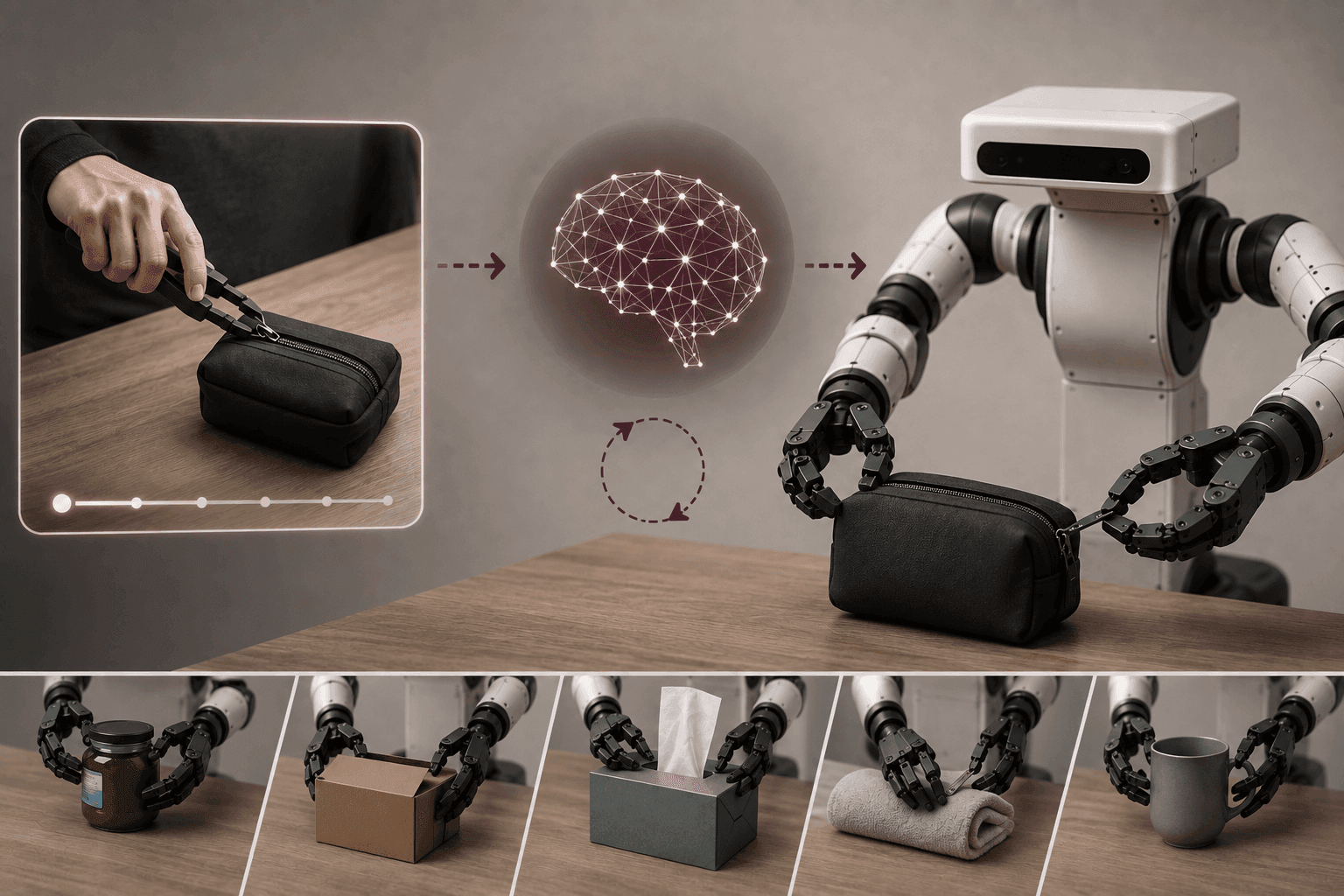
What if you only had to show a robot a task once? Not train it for hours, not hand it thousands of demonstrations. Just show it what to do, and let it try.
What if you only had to show a robot a task once? That's the idea behind GEN-1.5, a new embodied AI model from the startup Generalist. Instead of training for hours on thousands of examples, the GEN-1.5 robot model can take a short demonstration, sometimes just a few seconds, and attempt the task right away. It's one of the more striking ideas in recent embodied AI, so here's what it does and why it matters.
Learning from a single demonstration
The core idea is one-shot learning: teaching the robot a task from a single example. A person performs the task, often using handheld grippers, or the robot itself does a rough attempt, and that short clip, between 3 and 12 seconds, becomes the input the model works from.
Generalist calls this a "physical prompt." Rather than the thousands of demonstrations that learning-from-demonstration methods usually need, GEN-1.5 works from one. Show it what to do, and it tries to do it.
What a "physical prompt" actually means?
Here's the part that makes it unusual. The demonstration is not used to retrain the model. Its weights don't change at all. Instead, the demo is placed into the model's context window, its short-term memory, and stays there while the robot performs the task.
It's in-context learning, the same mechanism behind few-shot prompting in LLMs, applied to sensorimotor data. You paste an example into the context to condition the output, except here the example is a few seconds of physical demonstration rather than text, and the output is a closed-loop action trajectory rather than tokens.
Some specifics worth knowing. GEN-1.5 is a large multimodal model that ingests video, sensor, language, and proprioceptive inputs, holds roughly 30 seconds of context, and emits action trajectories at 100 Hz. The physical prompt is a 3 to 12 second demonstration dropped into that window, and inference runs with no gradient updates. Notably, Generalist reports no architectural changes to induce in-context learning, no meta-learning loop, and no auxiliary improvisation objective, the capability emerged from pretraining on physical interaction data at scale, which is the more interesting claim than any single demo.
How it adjusts, recovers, and improvises?
A robot that only mimicked the exact motion in the clip wouldn't be very useful, because the real world never lines up perfectly with the demo. GEN-1.5 goes further. When the situation changes, it can adjust its movements, recover from a mistake, and even improvise a different strategy to reach the same goal.
Physical prompts also compose. Generalist placed two independently recorded demonstrations, unzipping a pencil pouch and retrieving money from it, into the context together, and GEN-1.5 chained them into one continuous skill, generating the connective motions (repositioning, regrasping, error recovery) that appeared in neither clip. That is closer to planning over a library of primitives than to trajectory playback, and it runs straight into the contact-rich dexterity problems behind why robot hands are so hard.
Learning in simulation, acting in the real world
One of the most interesting results is that the demonstration doesn't have to come from the real world at all. Generalist showed GEN-1.5 learning from a demonstration performed in simulation, then carrying out the task on a real robot, without being trained on that specific task in either place.
The detail that makes this notable: Generalist says GEN-1.5's pretraining contains no simulation data, neither rendered video nor simulated dynamics, yet a rollout from the simulator still works as a valid physical prompt, and the prompted behavior transfers to the real scene. For tasks where that holds, demonstrations no longer have to be collected physically, they can come from whatever is cheapest to generate in simulation, which is a materially more scalable data path.
Why this matters, and where it falls short?
It's worth being honest about the results, which the company is too. Across ten tasks like opening a jar or pulling money from a purse, one-shot prompting succeeded around 59% of the time, rising to roughly 83% with a few minutes of extra task data. The tasks are short and simple, and the reliability isn't there yet for real deployment.
The significance lies elsewhere: a robot can now learn a new physical skill from a single example at all, across a broad range of tasks, which had largely been considered out of reach. It's the same shift toward general, promptable models seen in systems like Gemini Robotics 2. Instead of programming robots task by task, the question GEN-1.5 raises is a bigger one: what if the next generation of robots could simply learn by watching?
FAQ
- What is GEN-1.5? GEN-1.5 is an embodied AI foundation model from the startup Generalist. It can learn a new physical task from a single short demonstration (3 to 12 seconds) placed into its context, without any retraining or fine-tuning, and then attempt the task on a robot immediately.
- What is a "physical prompt"? A physical prompt is a short demonstration of a task, from a person using handheld grippers or from the robot itself, that's loaded into the model's context window as input. Like an example pasted into a chatbot prompt, it guides the model's behavior without changing its underlying weights.
- How is this different from normal robot learning? Most robot learning retrains or fine-tunes a model on many demonstrations. GEN-1.5 instead keeps a single demonstration in context and acts on it directly, with no training step, which is why it's described as one-shot, in-context learning rather than conventional training.
- How well does GEN-1.5 actually work? Generalist reports about 59% average success across ten short tasks from a single demonstration, rising to around 83% with a few minutes of additional task-specific data. The tasks are simple, and the company is clear that reliability is still early; the notable part is that one-shot learning works at all.
- Can GEN-1.5 learn from simulation? Yes. Generalist showed the model being prompted with a demonstration performed in simulation and then carrying out the task on a real robot, without task-specific training in either environment, which suggests a cheaper, more scalable way to gather demonstrations.
- How would you experiment with an approach like this yourself? In-context and demonstration-driven methods still depend on a simulation stack for collecting demonstrations, generating variations, and validating policies before real-robot rollouts. Drift generates ROS 2 and MuJoCo simulation workspaces from a natural-language prompt, which removes the scene-and-harness setup so you can focus on the demonstrations and the policy rather than the boilerplate around them.


