Research
Why Robot Hands Are So Hard?
Robot hands look more human every year, yet nobody has really solved them. Here's why grasping is so hard, and why most robots still use simple grippers.
A new robot hand goes viral every few months for how human it looks. Look past the demo reel and the same thing is true: nobody has really solved the robot hand.
Impressive hardware, but understanding why robot hands are hard means looking at what happens after the demo ends. Despite decades of work, dexterous manipulation remains unsolved, and most working robots today don't have hands at all.
Why most robots use grippers instead of hands?
Walk onto almost any factory floor and you won't see hands. You'll see grippers: two-finger pincers, three-finger claws, and often just a suction cup.
There's a good reason for that. The parallel-jaw gripper is one of the most successful pieces of hardware in automation history: one actuator, one degree of freedom, almost nothing to break, calibrate, or get wrong in software. A human hand has roughly 27 degrees of freedom. That gap is the entire engineering problem in miniature.
Every actuated degree of freedom you add is a tax: another motor, another failure mode, another thing that slips out of calibration before a demo. And for a huge fraction of real tasks, the gripper is enough. If the object always arrives in the same place, you don't need fingers, you need a clamp that closes reliably ten million times. Most robots get by without many fingers because most robots work in worlds we built for them.
What makes grasping so difficult in the real world?
Outside a factory, that structure vanishes. Every object has a different shape, weight, and texture, and it rarely shows up where you expect.
To pick something up, a robot has to perceive the object, choose where to grip it, and apply exactly the right amount of force. Too little and it slips. Too much and a paper cup or an egg is crushed. A person adjusts continuously without conscious thought, using a dense sense of touch that current robots don't come close to matching.
The hardware fights back too. A dexterous hand is one of the worst real-estate problems in robotics: 20-plus degrees of freedom packed into a hand-sized volume, light enough not to wreck the arm's dynamics. That leaves two painful options. Put the motors in the hand and it gets heavy, and mass at the end of an arm is the enemy of everything carrying it. Or run tendons from the forearm, the way a human hand does, and take on cables that stretch, wear, and snap. Add cost on top: research-grade hands have run as much as a car, and a single controller hiccup into a table can turn one into a paperweight.
The tactile sensing gap in robot hands
The deeper technical gap is touch. Available dexterous hands still fall well short of human hands, and tactile ability is where the shortfall is largest. A robot may see an object clearly and still have almost no sense of how it feels in its grip, whether it's slipping, or how the contact is changing as it moves.
There's also a data problem. Learning-based approaches need enormous amounts of high-quality manipulation data, and capturing how a human hand actually moves and touches things at that scale is difficult in itself. Much of this research happens in simulators like MuJoCo, where contact-rich tasks such as reorienting a cube in-hand can be practiced at scale, as covered in this survey of learning-based in-hand manipulation.
Simulation carries its own version of the problem. Contact dynamics, friction, deformation, and the exact moment a fingertip slips are where simulation and reality disagree most. The sim-to-real gap is a challenge everywhere in robotics, and in the hand it's at its worst.
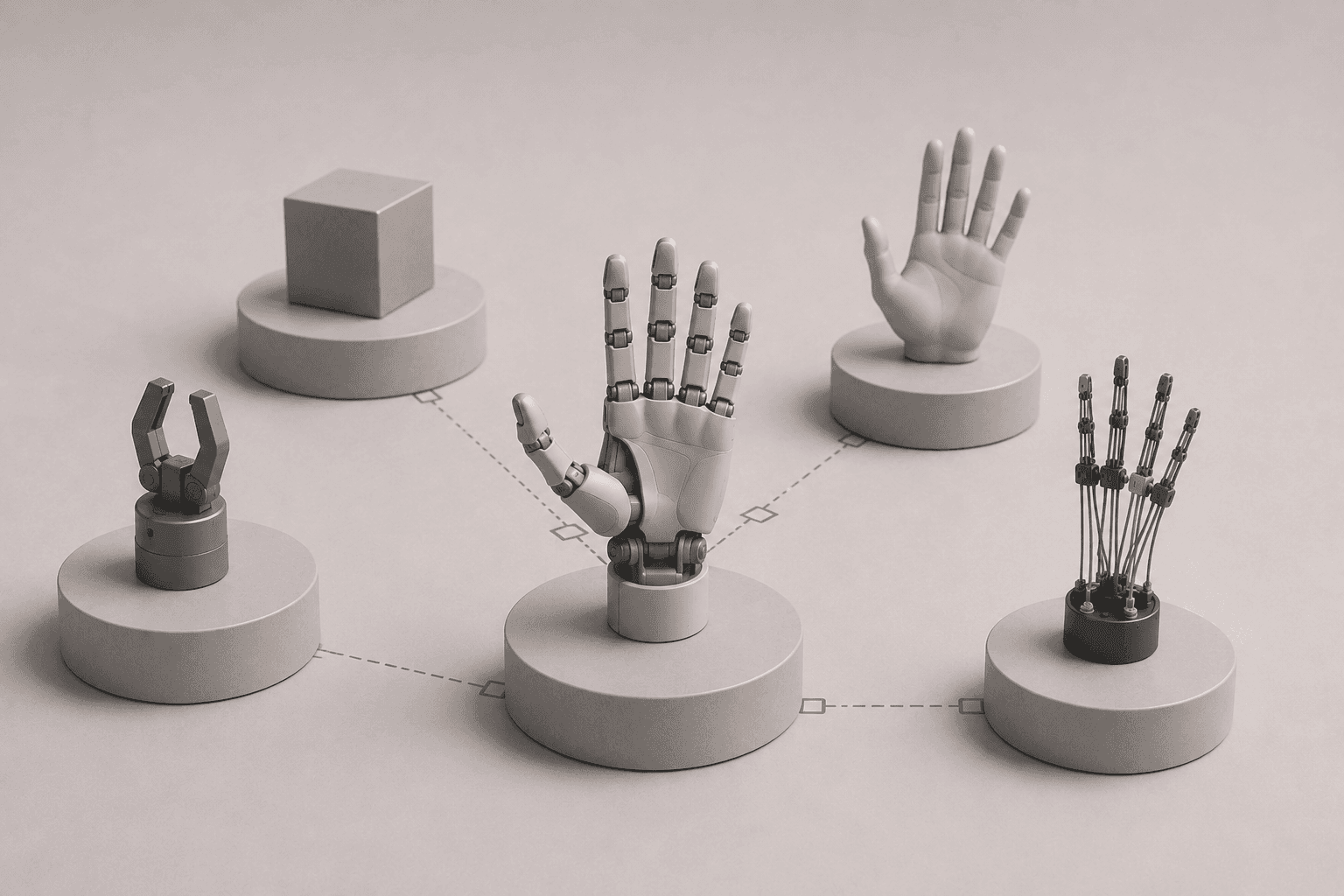
Underactuation, the middle path between two fingers and five
Framing this as two fingers versus five is a false choice, and some of the most interesting work sits in between.
The key idea is underactuation: mechanical design that produces dexterity-like behavior without a motor for every joint. An adaptive gripper that passively conforms to whatever it touches gets you a large share of human grasping with a fraction of the actuators. You put the intelligence in the mechanism rather than the motors. Evolution did something similar, since a lot of human grasping is mechanically coupled rather than independently controlled. You may not need to actuate everything in order to do everything.
Redesign the world, or build robots that fit it?
That raises a bigger question than finger count. There are two paths forward, and the industry is pursuing both.
One is to redesign the world for robots: structured warehouses, fixtures, conveyors, and packaging standardised so simple grippers suffice. That approach works, and it's why deployed robotics succeeds today. You've moved the complexity into the environment.
The other is to build robots dexterous enough to fit the world we've already built. Door handles, drills, light switches, knives, zippers, jar lids. None of it was designed for a claw, and all of it was designed implicitly around five fingers and a thumb. In human spaces, the human hand is the universal adapter. There's a quieter argument for it too: the internet is full of footage of human hands doing things, so the closer a robot's hand is to ours, the better that demonstration data transfers and the easier teleoperation becomes. The anthropomorphic form factor stops being vanity and becomes a data decision.
The catch is that you can only redesign the places you control. You can rebuild a warehouse. You can't rebuild every home, hospital, and messy human space built up over decades around human hands. This is what humanoid robots are betting on, and it depends on solving the hand.
Why hands are the frontier of physical AI?
AI is getting smarter every day, and models are getting far better at understanding instructions and recognizing objects. The gap now sits at the point of contact, in the moment a robot has to physically touch the world and get the force right. As our founder put it in a longer piece on this question, intelligence with nothing to act through is just text in a box. The hand is where physical AI becomes physical.
Until robots master their hands, embodied AI still has one of its biggest challenges ahead. It's also one of the most interesting places to work right now, because progress on hands unlocks a huge share of what people imagine robots doing.
If you want the longer argument behind this, read our founder's full piece on how many fingers a robot actually needs. And if you'd rather get hands-on, most of this research starts in simulation: try building a pick-and-place scene in MuJoCoand see how quickly grasping stops feeling simple.
FAQ
- Why are robot hands so hard to build? Because grasping requires perceiving an object's shape, weight, and texture, then applying exactly the right force to avoid dropping or crushing it. Robot hands also lack the dense sense of touch human hands have, and the training data needed to learn dexterous manipulation is scarce and difficult to collect.
- Why do most robots use grippers instead of hands? Grippers are cheaper, more reliable, and easier to control. In structured settings like factories, where the same object arrives in the same orientation repeatedly, a simple gripper handles the task perfectly without the cost and complexity of a multi-fingered hand.
- What is dexterous manipulation? Dexterous manipulation is a robot's ability to handle and reorient objects skillfully, typically with a multi-fingered hand. It covers tasks like adjusting an object within the grip, using tools, and handling unfamiliar shapes, and it remains an active area of research.
- Why is tactile sensing important for robot hands? Touch tells a robot whether an object is slipping, how much force it's applying, and how contact is changing as it moves. Vision alone can't provide that, which is why tactile sensing is considered one of the key missing pieces in dexterous manipulation.
- What is underactuation in robot hands? Underactuation means a hand has fewer actuators than joints, using mechanical design so fingers passively conform to an object instead of driving each joint independently. It delivers much of the benefit of a dexterous hand with far fewer motors, less weight, and fewer failure points.
- How many fingers does a robot actually need? It depends on where the robot works. In structured settings like warehouses, a one-degree-of-freedom gripper is often the correct answer. In homes, hospitals, and other spaces built around human hands, more dexterity becomes necessary, which is why the question is really about whether you redesign the world for robots or build robots to fit the world.
- How are robot hands researched and tested? A great deal of the work happens in simulation, where contact-rich tasks can be repeated at enormous scale without wearing out expensive hardware. Physics engines like MuJoCo are widely used for this, and tools like Drift generate the simulated robots and environments that experiments run in, while the manipulation policies themselves are trained on top.