Research
PID vs. MPC vs. Reinforcement Learning: How Robots Control Movement
Three approaches to robot control, from correcting movement errors to predicting trajectories and learning actions through experience.
Three ways to control a robot. Which one actually works best?
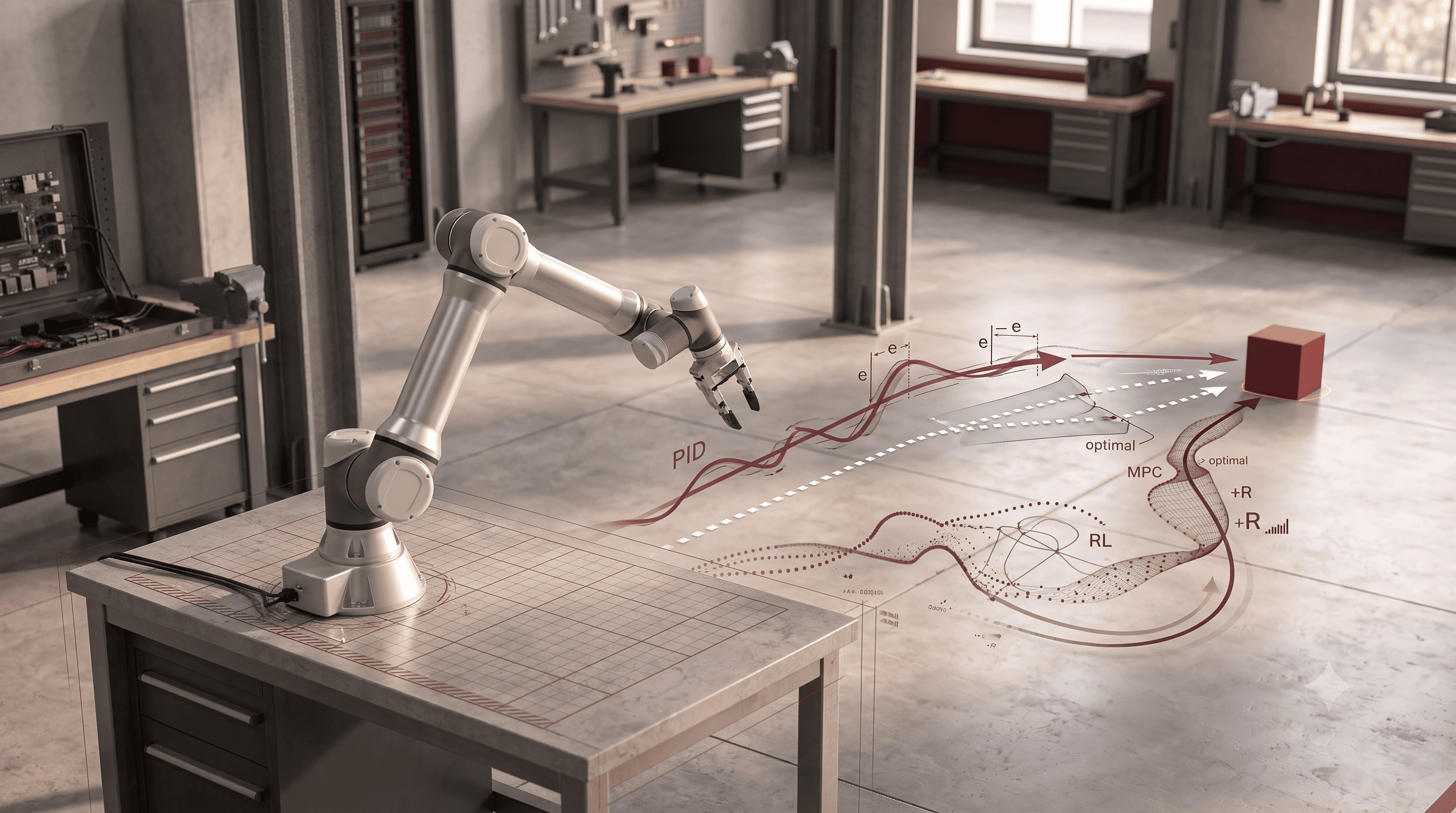
Imagine a robot arm that needs to move from its starting position to a target. The objective is straightforward, but how the robot decides which movements to make can vary significantly. One controller can continuously correct its errors, another can predict future movement before acting, and a third can learn a control policy through experience.
These approaches are known as PID control, Model Predictive Control (MPC), and Reinforcement Learning (RL). All three can help robots move accurately, but they approach the problem from different directions.
1. PID: Correct the Error
PID stands for Proportional-Integral-Derivative. It is a widely used feedback-control method that adjusts a system's input based on the difference between its current state and its desired state.
For a robot arm, this difference is called the error. If a joint is supposed to reach a particular angle but hasn't arrived there yet, the controller uses that error to calculate a correction. The proportional term responds to the current error, the integral term accounts for accumulated error over time, and the derivative term responds to how quickly the error is changing.
Together, these terms help the arm approach its target and settle into position. The controller repeatedly measures the error and adjusts its output, allowing it to respond to disturbances rather than relying entirely on a fixed movement sequence.
PID's biggest advantage is its simplicity. It is relatively inexpensive to run, widely supported by robotics software, and effective for many motor-position and velocity-control tasks when properly tuned. ROS 2, for example, provides PID-based controllers through its control framework.
There are limitations, though. A basic PID controller doesn't inherently predict what the robot will do several steps into the future. Complex interactions, multiple coupled joints, actuator limits, and obstacle constraints may require additional planning or control methods.
2. MPC: Predict Before Acting
Model Predictive Control takes a different approach. Instead of calculating a correction based only on the current error, MPC uses a model of the system to predict how different control inputs could affect its future movement.
Imagine the same robot arm moving toward a target while needing to avoid an obstacle and stay within its joint limits. Rather than simply correcting its position, MPC can evaluate candidate movements over a future time horizon and optimize for objectives such as reaching the target smoothly while respecting constraints.
The process repeats in a loop. The controller measures the robot's current state, predicts possible future trajectories, solves an optimization problem, and applies the first action from the selected sequence. It then measures the updated state and solves the problem again. This is known as receding-horizon control.
MPC is particularly useful when future motion matters. It can explicitly account for constraints such as actuator limits, joint ranges, and certain obstacle-avoidance requirements, depending on how the optimization problem is formulated. It is used in areas ranging from industrial manipulation to legged-robot locomotion.
The trade-off is computational cost. MPC needs a reasonably useful model of the robot and enough computing capacity to solve its optimization problem at the required control frequency. More complicated models and constraints can make that process expensive.
3. Reinforcement Learning: Learn Through Experience
Reinforcement Learning approaches robot control as a learning problem.
Instead of manually specifying every control response, a developer defines a task, an environment, and a reward signal. The robot's policy selects actions, receives feedback about the outcomes, and is improved through training to maximize its expected reward.
For the robot arm, the reward might encourage reaching the target accurately, penalize excessive movement, and discourage collisions. Through repeated interaction, the policy can learn which actions tend to produce better outcomes.
Unlike PID, RL does not require the final action-selection policy to be hand-designed around a fixed feedback equation. Unlike conventional MPC, a learned policy does not necessarily need to solve an optimization problem over future trajectories every time it acts. The training process can instead move much of the learning computation offline, although the exact approach depends on the algorithm.
RL can be useful for complex behaviors that are difficult to encode manually, including manipulation and locomotion. However, it can require substantial training data and careful reward design. Exploration can also be unsafe on physical hardware, so researchers often train policies in simulation before evaluating them on real robots.
For example, training a Franka Panda to push a cube with reinforcement learning demonstrates how a robot can learn a manipulation behavior through a reward-driven training process.
RL also introduces a different set of challenges. A policy that performs well in simulation may struggle when transferred to a physical robot because of differences in friction, sensing, dynamics, or contact. Training success does not automatically guarantee reliable real-world behavior.
4. Which Control Method Should You Choose?
There isn't a universal winner. The right approach depends on the robot, the task, the available model, the computational budget, and how much training data is available.
| Factor | PID | MPC | Reinforcement Learning |
|---|---|---|---|
| Main approach | Correct measured error | Predict and optimize future actions | Learn a policy from experience |
| Model required | Not necessarily a full dynamics model | Yes, typically an explicit predictive model | Depends on the RL method |
| Runtime cost | Usually low | Can be computationally intensive | Often relatively low for a trained policy |
| Constraints | Usually need additional logic for complex constraints | Can incorporate constraints into optimization | Must learn or be designed to respect constraints |
| Best fit | Routine motor and position control | Predictive control with constraints | Complex behaviors that benefit from learning |
For a straightforward joint-position task, PID may be all that's needed. If a robot must plan its movement while respecting several constraints, MPC may be the better fit. If the desired behavior is difficult to specify manually and enough training experience is available, RL may offer a useful alternative.
These methods can also work together. A learned policy might provide high-level actions while conventional controllers stabilize individual joints. MPC can plan motion while lower-level feedback controllers execute it. In practice, many robotic systems combine multiple layers rather than relying on one technique for everything.
That is the important distinction: PID corrects, MPC predicts, and reinforcement learning learns. Understanding those differences helps explain why robot control is not a competition with one winner, but a set of tools for different problems.
FAQ
What is the main difference between PID and MPC?
PID calculates feedback corrections from the current and past error, along with the error's rate of change. MPC uses a model to predict future behavior and optimizes a sequence of possible control actions, applying the first action before replanning.
Is reinforcement learning better than PID for robotics?
Not necessarily. PID is often a better choice for simple, well-understood control loops. RL can be useful for complex behaviors that benefit from learning, but training, reward design, safety, and real-world transfer introduce additional challenges.
Does MPC require an accurate robot model?
MPC requires a model that is useful for predicting the system's behavior over its planning horizon. Model inaccuracies can reduce performance, although robust and adaptive MPC methods can account for some uncertainty.
Can PID, MPC, and RL be used together?
Yes. A robot can use a learned policy for high-level behavior, MPC for trajectory planning, and PID controllers for low-level joint control. The architecture depends on the application and its performance requirements.
Why is reinforcement learning often trained in simulation?
Simulation allows researchers to run many training episodes without repeatedly risking physical hardware. It can accelerate experimentation, but the resulting policy still needs careful evaluation because simulated dynamics may differ from reality.
Related Reading
- Training a Franka Panda to Push a Cube With Reinforcement Learning — a practical example of learning a robot behavior through reward-driven training.
- Best Robot Simulators for ROS 2: A 2026 Comparison — how different simulation environments support robotics development and testing.
- Why Robots Train in Simulation Before the Real World? — why simulated experience is useful when developing and evaluating robot policies.
- MuJoCo: The Physics Engine Robotics Quietly Runs On — the physics simulation foundation behind many robot-control and learning experiments.