
Research
Why Folding Laundry Is So Hard for Robots?
Folding a T-shirt takes us seconds but stumps most robots. Here's why deformable fabric makes laundry one of the hardest manipulation tasks in robotics.
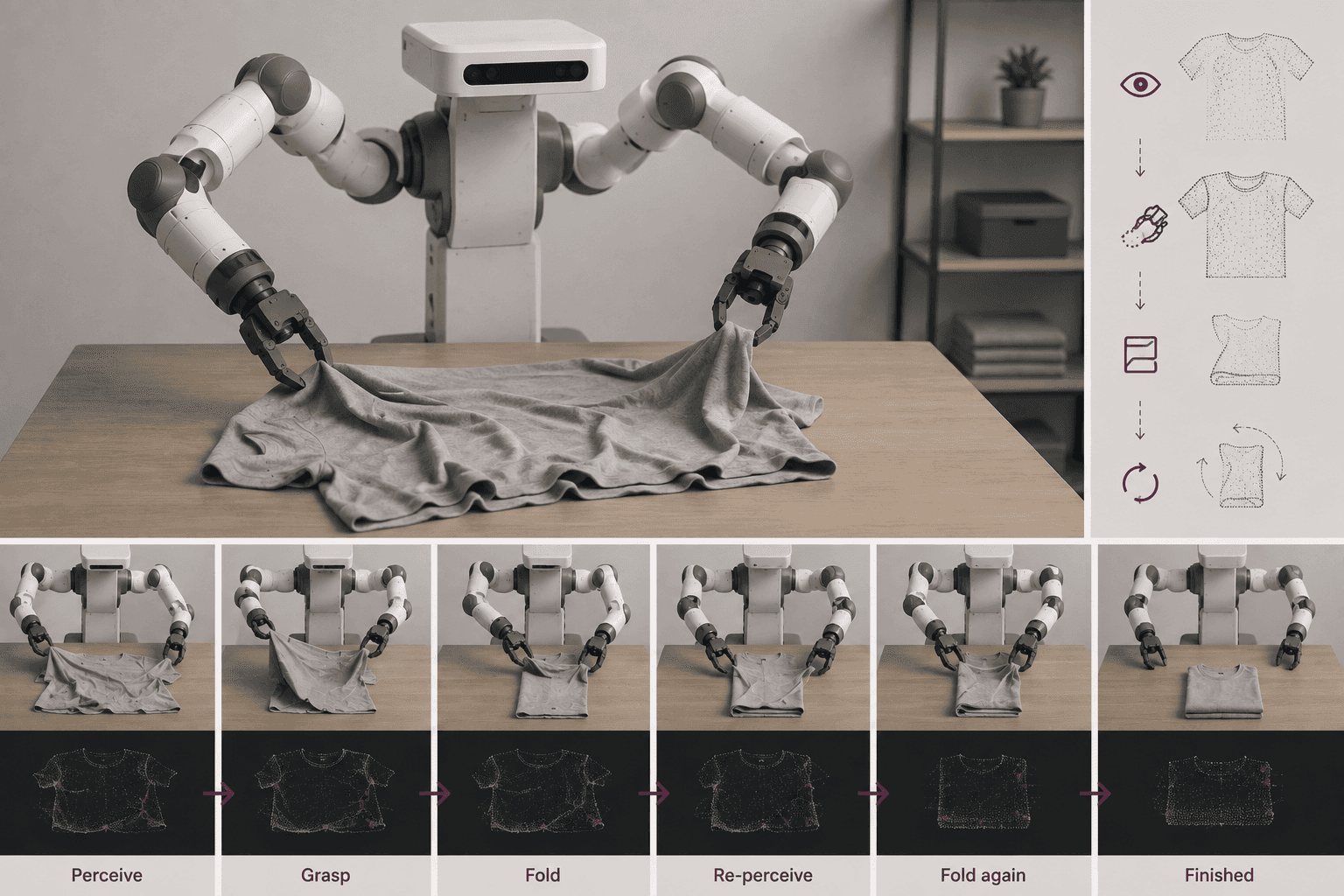
Folding a T-shirt takes you a few seconds without thinking. For a robot, it's one of the hardest manipulation problems there is.
The short version: a robot is great at handling objects that hold their shape, and terrible at objects that don't. Laundry is the second kind.
Fabric has no fixed shape
The core problem is that a piece of clothing has no fixed shape. A rigid object like a cube or a mug looks essentially the same every time, so a robot can model it once and plan around it. Fabric refuses to cooperate.
A shirt can wrinkle, stretch, drape, and fold over itself, and it looks completely different from one moment to the next. Drop it on a table twice and you get two entirely different shapes. This is what roboticists call a deformable object, and it breaks the assumption most manipulation relies on, that the thing you're grasping has a predictable form. It's a whole tier harder than the rigid-object grasping behind why robot hands are so hard.
Finding the edges, sleeves, and collar
Because the shape is never the same twice, the robot's first job is perception. Before it can fold anything, it has to look at a crumpled heap of fabric and work out where the meaningful parts are: the edges, the sleeves, the collar, the hem.
That's genuinely hard. A human glances at a shirt and instantly parses its structure, even bunched up. A robot has to infer all of that from camera data alone, on an object with no consistent appearance. This is the perception half of embodied AIworking at the edge of what current vision can do.
Grasping the right spot without disturbing the rest
Once the robot has identified a useful point, like a shoulder or a corner, it has to grab exactly that spot without disturbing everything else. Fabric moves in response to the lightest touch, so reaching in to pinch one sleeve can easily drag, bunch, or flip the rest of the shirt.
A rigid object stays put while you position the gripper. Cloth reacts to contact before you've even grasped it, which means the robot has to account for how the whole garment will shift as it moves in. Precise, gentle grasping on something that keeps rearranging itself is a serious control challenge.
Every fold changes the scene
Here's the part that makes laundry especially brutal. Every fold changes the scene. The moment the robot completes one fold, the shirt is a different shape than the plan assumed, and the part it needs to grab next may now be hidden underneath a flap of fabric.
So the robot can't compute one plan and execute it blindly. It has to perceive the garment again after every single action, re-locate the parts it needs, and adjust, over and over. This constant sense-plan-act loop on an object that transforms with each step is far harder than executing a fixed sequence on a rigid object that stays where you put it.
Why laundry is a benchmark for household robots?
All of this is exactly why laundry has become such a good test for household robots. It concentrates the hardest parts of real-world manipulation into one ordinary chore: unpredictable shape, delicate grasping, and a scene that changes with every move.
If a robot can reliably fold a shirt, it's demonstrating the skills needed to handle the messy, deformable, ever-changing objects that fill a real home, from towels and bags to food and packaging. That's why leading robotics teams use tasks like folding and bag manipulation to show real progress, and why it connects to the broader push to build capable household robots. To us, it's just a T-shirt. To a robot, it's a constantly changing object, and mastering it is a real milestone.
FAQ
- Why is folding laundry so hard for robots? Because fabric has no fixed shape. A shirt wrinkles, stretches, and folds over itself, looking different every time, so a robot can't rely on a memorized model. It has to perceive the garment's structure, grasp delicate points without disturbing the rest, and re-plan after every fold, since the scene changes with each move.
- What is a deformable object in robotics? A deformable object is one that changes shape when handled, like cloth, rope, food, or bags, as opposed to a rigid object like a cube that keeps its form. Deformable objects are much harder for robots because their shape is unpredictable and reacts to contact.
- Why is folding laundry considered a good test for household robots? Laundry combines the hardest parts of home manipulation in one task: unpredictable shape, gentle and precise grasping, and a scene that changes after every action. A robot that can fold laundry reliably is showing it can handle the messy, deformable objects common in real homes.
- Why can't a robot just follow a fixed folding sequence? Because every fold changes the shape of the garment, and the next part the robot needs may end up hidden or moved. It has to re-perceive the shirt and re-plan after each action rather than blindly executing a memorized set of motions.
- How do robots learn to handle fabric and other deformable objects? Largely through learning from data and demonstrations, and through practice in simulation, where deformable-object handling can be attempted many times safely. Tools like Drift generate the simulated robots and environments used to develop and test manipulation before it runs on real hardware.


