Research
Why Robots Need to Understand Space, Not Just Objects
Robots need more than object recognition. Spatial intelligence helps them understand where things are, how they relate, and how the world changes.
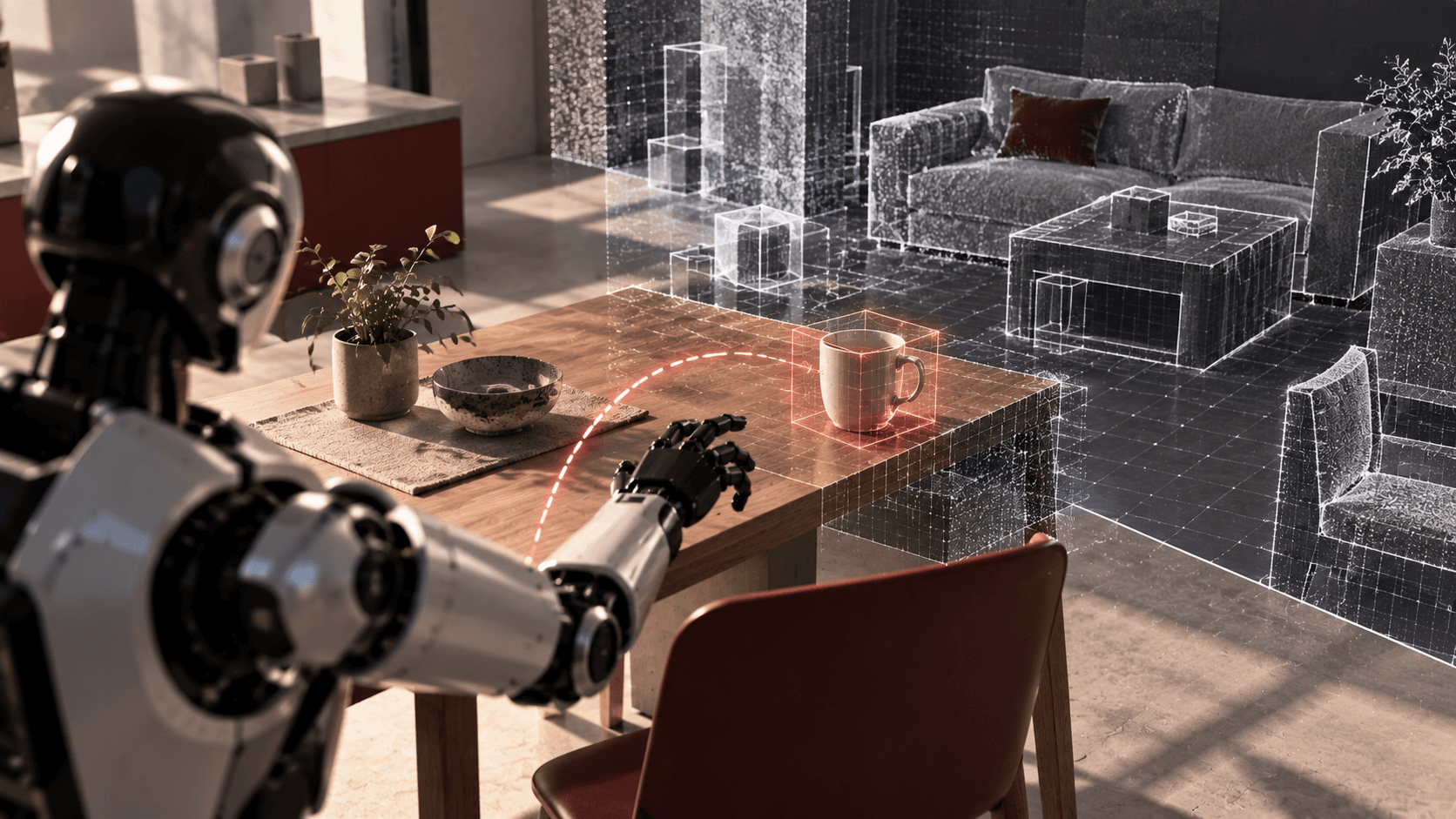
A robot knowing that something is a cup isn't enough. It also needs to understand where that cup is.
Is it on the table or on the floor? Is another object blocking it? Can the robot reach it from where it is standing? What happens if it moves closer? These questions turn simple object recognition into something much harder: understanding the object in relation to the world around it.
That is what spatial intelligence is about.
For robots, recognizing objects is only the beginning. To act reliably, they need to build an understanding of space, movement, geometry, and the relationships between things in their environment.
Seeing an Object Isn't the Same as Understanding It
A conventional vision system might tell a robot that there is a cup somewhere in its camera view. But knowing that the object is a cup doesn't tell the robot everything it needs to interact with it.
The robot needs to estimate its position, understand its orientation, determine how far away it is, and account for the objects surrounding it. If the cup is behind another object, partially occluded, or close to the edge of a table, those spatial relationships can completely change how the robot should approach it.
The problem becomes even harder once the robot starts moving.
A robot needs to maintain an understanding of its surroundings as its own position changes. Objects that looked reachable from one location may become obstructed from another. A path that appears clear may disappear when the robot moves around a corner. An arm reaching toward an object can also change what the robot can see.
This is why perception and action cannot be treated as completely separate problems. A robot needs to understand where things are, how they relate to one another, and how those relationships change when it acts.
That is a major part of what makes spatial intelligence important for embodied AI.
From 2D Recognition to a World Model
One way to think about spatial intelligence is the difference between recognizing a scene and building a model of it.
A camera image gives a robot a particular view of the world. A spatially intelligent system needs to go further, reasoning about the underlying environment even when parts of it aren't directly visible.
That can involve reconstructing the geometry of a room, estimating the positions of objects, understanding depth, tracking movement, and predicting what the environment might look like from another viewpoint.
This is where world models become interesting.
Instead of treating the world as a sequence of unrelated images, a world model attempts to represent the environment in a way that supports reasoning about what happens next. For a robot, that could mean understanding not just where an object is now, but what might happen when the robot reaches for it, moves around it, or pushes it.
We've previously looked at how world models are changing robot intelligence, but spatial intelligence adds an important physical dimension to that discussion. A useful model of the world has to capture the relationships that matter when an agent actually moves through it.
Why World Labs' Atlas Is Interesting
This is what makes World Labs' Atlas particularly interesting.
World Labs describes Atlas as a world model that can reconstruct and understand environments in 3D. Rather than simply generating another image, Atlas is designed to represent a world in a form that can be explored from different viewpoints and used to reason about how a scene behaves over time.
One particularly relevant capability is the connection between reconstruction and simulation. World Labs says Atlas can generate interactive 3D worlds from real-world inputs, creating environments where objects and scenes can be explored and manipulated. Those generated worlds can then be used as environments for embodied AI and robotics research. (World Labs)
That creates an interesting bridge between seeing the world and practicing inside it.
Imagine a robot encountering a new room. Instead of only identifying a table, chair, or cup, a spatial model could provide a richer representation of the room: where objects are located, how the spaces connect, what areas are accessible, and how the scene might change as the robot interacts with it.
The same reconstructed environment could potentially become a simulation where an embodied system tests actions before executing them in reality.
This is especially relevant because physical robot training is expensive. We've covered why robots train in simulation before the real world, and spatial world models could make that loop more closely connected to real environments.
The Next Step Is Understanding the World in Context
Robotics has spent decades getting machines better at sensing and recognizing their surroundings. But recognition alone doesn't tell a robot what it can do.
A robot needs to connect what something is with where it is, what surrounds it, and what could happen if it acts.
That is the difference between seeing a cup and understanding how to pick it up.
Spatial intelligence could become an important layer between perception and action, giving robots a richer internal representation of the environments they operate in. World models such as Atlas point toward a future where those representations can also become interactive spaces for reasoning, prediction, and simulation.
The next generation of robots won't just need to recognize what's around them.
They'll need to understand the world they're moving through.
FAQ
What is spatial intelligence in robotics?
Spatial intelligence is the ability of an AI system or robot to understand objects and environments in terms of their position, geometry, relationships, movement, and interactions.
Why isn't object recognition enough?
Recognizing an object doesn't tell a robot where it is, whether it can reach it, what is blocking it, or how its position relates to other objects. Those spatial relationships are essential for physical action.
What is a world model?
A world model is an internal representation of an environment that can support reasoning about its structure, states, and potential changes. In robotics, this can help connect perception with planning and action.
What is World Labs' Atlas?
Atlas is a world model from World Labs designed to reconstruct and represent real environments in 3D and support interactive exploration and simulation. World Labs positions it as infrastructure for applications including embodied AI and robotics. (World Labs)
How could spatial intelligence help robots?
A stronger spatial representation could help robots navigate unfamiliar environments, understand object relationships, plan movements, manipulate objects, and reason about how actions could change their surroundings.
Related Reading
- Add a LiDAR Sensor to a Robot Simulation in ROS 2 : directly connects to how robots perceive their surroundings.
- Adding SLAM to a Warehouse Robot With LiDAR in Gazebo : strong link to mapping, localization, and building a spatial representation of an environment.
- Teaching a Robot to Find Its Own Path : connects spatial understanding to path planning and navigation.
- 5 Ways Robots Learn Without Being Programmed :broader connection to embodied learning and how robots turn perception into action.