
Research
Swarm Robotics: Why a Thousand Simple Robots Beat One Smart One
Swarm robotics deploys many simple robots that follow basic rules with no leader. Together they produce complex, emergent behavior, like ants, bees, and drones.
One ant isn't much. Thousands of ants build colonies and solve hard problems. Swarm robotics asks what happens when robots work the same way.
A single ant isn't particularly impressive. But thousands of ants working together can build colonies, find food, and solve surprisingly complex problems. Swarm robotics asks a simple question: what if robots worked the same way? Instead of one highly capable machine, you coordinate many simple ones, and capability comes from the group.
What is swarm robotics?
Swarm robotics is an approach to robotics where many simple robots coordinate to accomplish tasks that a single robot would struggle with. Traditional robotics usually focuses on making one robot smarter and more capable, the kind of single mobile robot you stand up from scratch. Swarm robotics takes the opposite approach: deploy lots of inexpensive, simple robots that each follow a few basic rules.
Individually, those robots aren't very intelligent. Together, they can look surprisingly smart. The intelligence lives in the group, not in any one machine.
How swarm robotics works?
Here's the part that surprises people. Most swarm robots don't have a leader. No single robot is in charge, and no robot holds the master plan. Each one follows a few simple rules and reacts to what's happening immediately around it, using only local information from its nearest neighbours.
That decentralisation is the point. Because no robot is essential, the swarm keeps working even if individuals fail, and it scales from a handful of robots to thousands without redesigning the system. Each robot is still running its own small sense, think, act loop; the swarm just runs thousands of them at once.
Emergent behaviour: how a swarm gets smart without a plan
When hundreds or thousands of robots follow those simple rules at the same time, something interesting happens. Complex, coordinated behavior starts to emerge that no single robot was programmed to produce. No robot knows the full plan, yet the swarm as a whole behaves as if it does. This is called emergent behavior.
A famous demonstration came from Harvard, where researchers built a swarm of more than a thousand tiny robots called Kilobots that could self-assemble into shapes like a star or a letter with no central control. Each Kilobot followed the same simple program and only talked to its neighbors, and the shapes appeared from the group, mistakes self-correcting along the way.
Swarm robotics examples: drones, warehouses, and search and rescue
The idea is already in use:
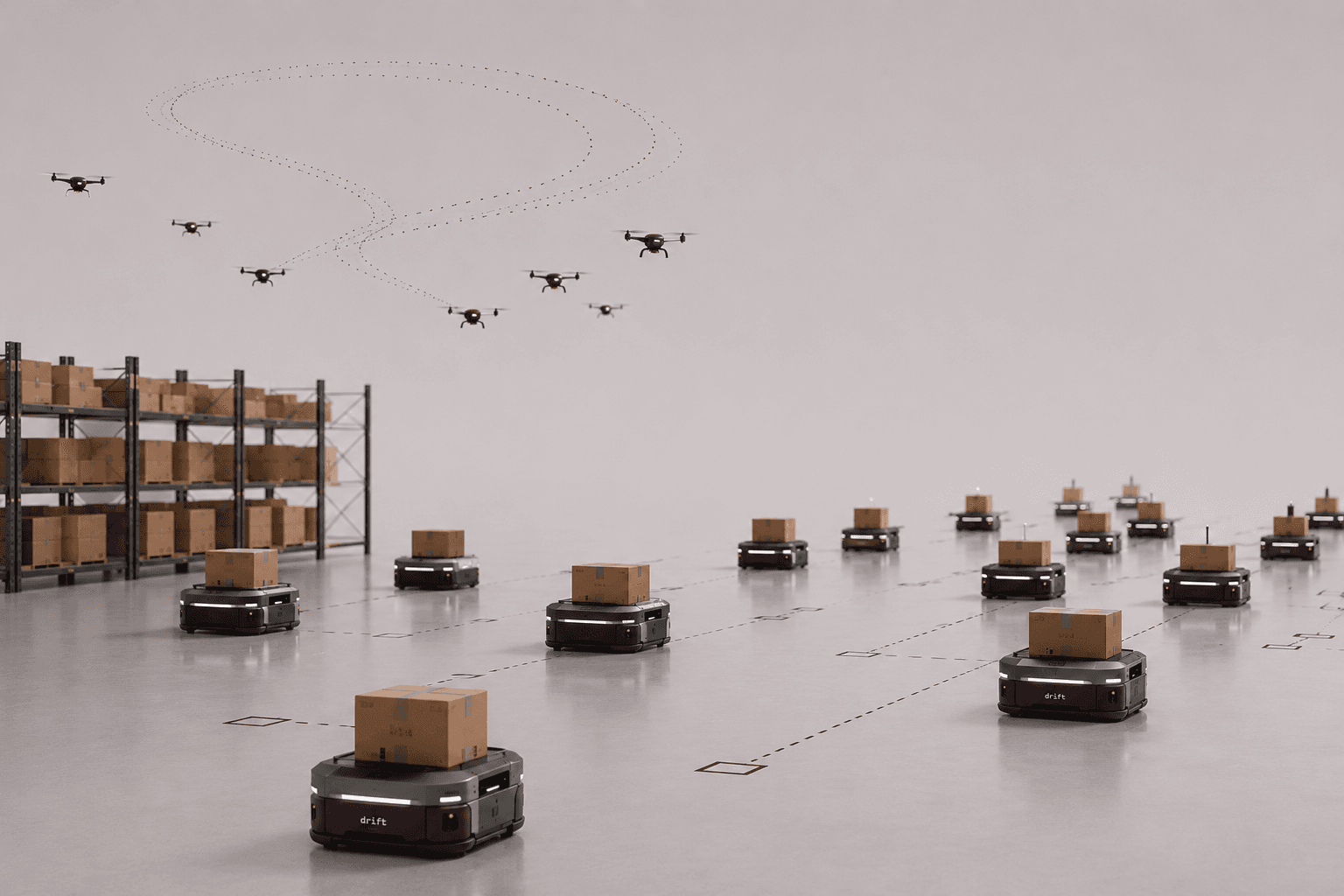
- Drone swarms can coordinate massive aerial formations, the kind you see in light shows, without a central pilot steering each drone.
- Warehouse robots move inventory around a facility while avoiding each other, keeping goods flowing without constant traffic jams.
- Search-and-rescue swarms spread out to explore large or dangerous areas at the same time, covering far more ground than a single robot could.
Simulating these systems is its own challenge, since you need a simulator that handles many robots at once. If you're curious how the tools compare, see our robot simulators guide.
Inspired by nature: ants, bees, and termites
None of this is new. Nature has been doing it for millions of years. Ants, bees, and termites have no master plan and no manager, yet together they achieve things far beyond any individual: bridges built from bodies, hives run with precision, mounds engineered for airflow. It's the same instinct that gives us soft robots: when biology has already solved a problem, it's often easier to borrow the answer than invent a new one.
Swarm robotics is built on the same principle. Sometimes the smartest system isn't a single brilliant machine at all. It's a thousand simple robots, each following easy rules, adding up to something none of them could do alone.
FAQ
- What is swarm robotics? Swarm robotics is an approach where many simple robots coordinate to perform tasks collectively. Rather than building one highly capable robot, you deploy lots of basic ones that follow simple rules, and useful group behavior emerges from their interactions.
- How does swarm robotics work? Each robot follows a few simple rules and reacts to its nearby neighbors using local information. There's usually no leader and no central plan. Because control is decentralized, the swarm scales easily and keeps working even if some individual robots fail.
- What are examples of swarm robotics? Common examples include drone swarms that fly in coordinated formations, warehouse robots that move inventory while avoiding collisions, and search-and-rescue swarms that spread out to explore large areas. Harvard's thousand-robot Kilobot swarm is a well-known research example.
- What is emergent behavior in swarm robotics? Emergent behavior is complex, coordinated group behavior that arises from many robots following simple individual rules. No single robot is programmed with the overall outcome, yet the swarm as a whole produces it.
- What is swarm robotics inspired by? It's inspired by social insects and other collective systems in nature, especially ants, bees, and termites, which accomplish complex tasks through the simple, local actions of many individuals rather than central control.
- Can Drift build swarm robotics simulations? Drift generates simulation workspaces for individual robots in ROS 2, including the robot description, sensors, controllers, and world. Swarm behavior, where many robots coordinate through shared rules, is a separate layer built on top of those single-robot simulations, so Drift handles the per-robot foundation rather than the swarm coordination itself.


