Research
What NVIDIA Isaac Lab 3.0 Changes for Robot Learning
Break down NVIDIA's major simulation update: modular physics backends, kit-less workflows, and real-time execution with Isaac OS.
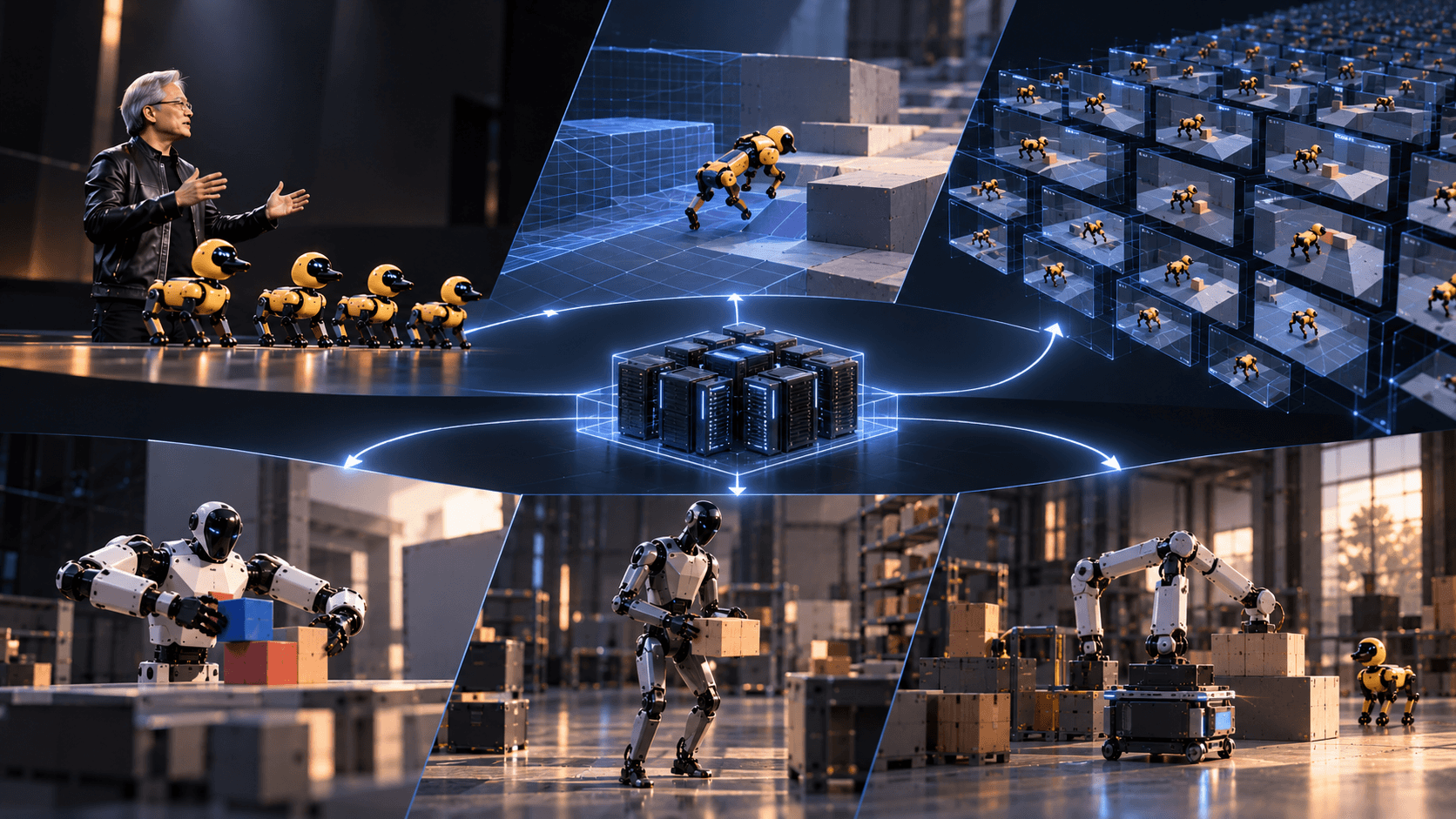
Simulation has become an essential prerequisite for physical AI, yet roboticists frequently run into friction when platforms lock them into rigid toolchains. At GTC Berlin, NVIDIA announced the general availability of Isaac Lab 3.0, showcasing the update alongside quadrupedal and bipedal "Microduck" robots running policies trained across thousands of parallel instances. Isaac Lab 3.0 introduces a modular multi-backend architecture and the broader Isaac OS runtime, designed to integrate simulation, reinforcement learning, and hardware deployment into a unified pipeline.
Modular Architecture and Kit-Less Simulation
Historically, utilizing NVIDIA's simulation framework required launching the full Omniverse Kit and PhysX stack. Isaac Lab 3.0 breaks that dependency by decoupling the robot learning interface from any single physics solver or rendering engine.
The new architecture operates like an open switchboard rather than a locked-down suite. Developers can run training on the Newton Physics Backend, a lightweight solver environment optimized for GPU throughput that supports MuJoCo-Warp alongside fluid and deformable materials. Teams needing PhysX collision precision or RTX ray tracing can tap standalone runtimes directly without launching the desktop Omniverse interface. Training can even run headless in a background terminal or stream state updates to lightweight web viewers. This flexibility lets researchers focus compute on policy learning rather than interface overhead.
Massive Parallelism and the Sim-to-Real Gap
Reinforcement learning for dynamic systems demands millions of environmental interactions to establish stable locomotion and manipulation policies. During the Berlin demonstrations, NVIDIA showcased how high-throughput simulation prepares hardware for the physical world through live tests with "Microduck" prototypes.
Isaac Lab 3.0 uses GPU acceleration to step thousands of simulated robot instances simultaneously on a single computing cluster. Across these digital environments, virtual robots stumble, slip on randomized friction patches, recover from sudden forces, and explore contact boundaries at the same time. Exposing the model to wide variations in digital dynamics produces robust control policies capable of transferring zero-shot to physical hardware without manual parameter re-tuning in the lab.
Beyond Simulation and Policy Deployment
Simulation throughput matters only if learned policies make a clean transition to embedded hardware. Alongside the simulation update, NVIDIA introduced Isaac OS, an open-source runtime framework built on NVIDIA Holoscan to connect decision models, multi-modal sensor inputs, and motor controllers directly on physical machines.
This setup establishes a straight line from digital training to hardware deployment. A policy trains across thousands of parallel runs in Isaac Lab, exports cleanly with standardized sensor parameters, and loads straight onto the robot via Isaac OS. The onboard runtime handles real-time camera streams, processes joint states, and drives physical motors without translation layers. This directly tackles the software fragmentation explored in our look at why robots practice in simulation before the real world.
The Shift Toward Full-Stack Embodied AI
Isaac Lab 3.0 indicates that robotics tooling is shifting away from isolated simulators toward end-to-end development platforms. By supporting multiple physics engines, enabling lightweight runtimes, and connecting simulation directly to robot execution through Isaac OS, NVIDIA reduces the technical friction in building physical AI. The broader task in robotics is no longer just finding a stable physics engine, but creating a smooth pipeline that turns synthetic training into dependable physical action.
FAQ
What is NVIDIA Isaac Lab 3.0?
Isaac Lab 3.0 is an open-source, GPU-accelerated framework designed for robot learning, reinforcement learning, and imitation policy training, offering modular interfaces for multiple physics solvers and rendering engines.
How does Isaac Lab 3.0 differ from earlier versions?
Earlier releases required the full Omniverse Kit and desktop interface. Version 3.0 introduces a modular, kit-less architecture that lets developers run lightweight Python scripts with solvers like Newton or standalone PhysX without opening the heavy desktop application.
What is NVIDIA Isaac OS?
Isaac OS is an open-source runtime framework based on NVIDIA Holoscan that connects onboard AI models, sensor data streams, and motor controllers directly on physical robots, bridging the gap between simulation-trained models and hardware execution.
Can Isaac Lab 3.0 run without an NVIDIA Omniverse desktop installation?
Isaac Lab 3.0 supports kit-less training workflows using lightweight Python environments, Warp-native physics, and standalone visual tools like Viser or Rerun without the full desktop app installed.