Research
Helix 2.5: Zero-Shot Robot Generalization
Figure's Helix 2.5 performed household tasks across 30 unseen homes, showing how broad human data could help humanoid robots generalize.
Imagine walking into a house you've never seen before and immediately knowing how to clean it. You don't need to study the floor plan first or relearn how to make a bed because the mattress is a different height. You already understand enough about homes, objects, and everyday tasks to figure it out.
That's the problem Figure is trying to solve with Helix 2.5.
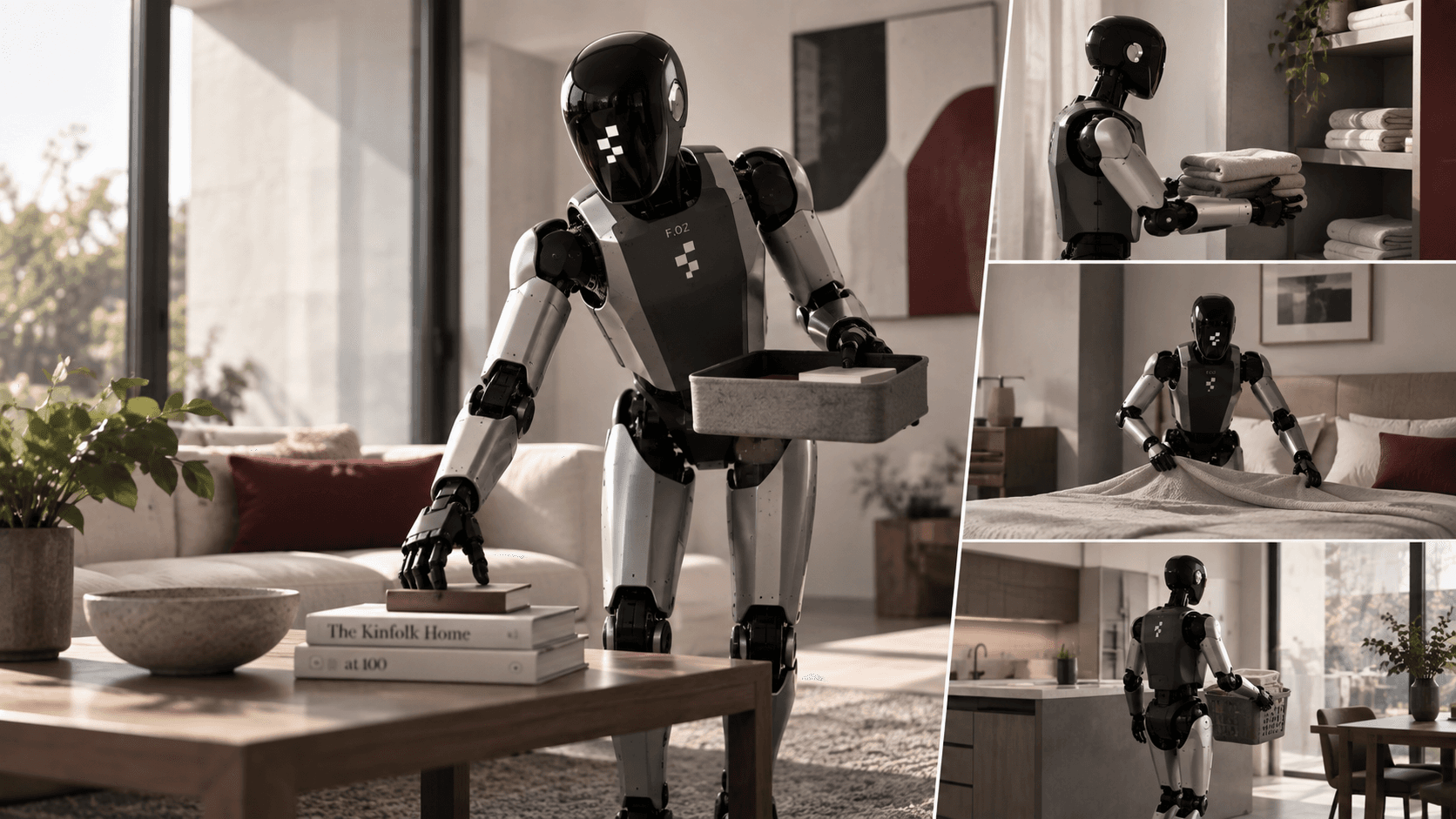
Figure's latest humanoid system was pretrained on Index, its large-scale dataset of human behavior, and then evaluated across 30 previously unseen Bay Area homes. The robot performed three household behaviors: tidying living rooms, folding towels, and making beds. Crucially, Figure says it collected no data in those evaluation homes and did not fine-tune or adapt the model to their layouts or objects.
The result points toward a different way of thinking about robot training: instead of teaching a robot how to work in every environment individually, give it enough experience with the physical world that it can transfer what it already knows to somewhere new.
The Problem With Teaching Robots One Place at a Time
Robots tend to work best when the environment they operate in resembles the environment they were trained for. That makes sense. A robot that has learned where objects usually appear, how much space it has to move, or how a particular task unfolds can perform well when those conditions stay predictable.
Homes don't work that way.
Furniture moves. Objects appear in different places. Rooms have different layouts. A bed might be against a wall in one house and surrounded by open space in another. Even something as simple as folding a towel can involve different starting positions, surfaces, and shapes.
For a humanoid robot, these changes affect much more than manipulation. It may need to walk through a room, position its body correctly, reach around furniture, perceive an object, grasp it, and continue moving while manipulating it. Figure describes Helix 2.5's evaluated behaviors as whole-body tasks involving locomotion, manipulation, bimanual coordination, and active perception.
That is why generalization matters. A robot that can perform a task in one carefully prepared room is demonstrating a skill. A robot that can take that skill into an unfamiliar room is demonstrating something closer to reusable physical knowledge.
Index Gives Helix a Broader Starting Point
The foundation for Helix 2.5 is Figure's Index dataset, which is built from videos of people performing real-world tasks across homes, workplaces, and other environments.
Figure launched Index in August 2026 as a large-scale effort to collect diverse physical behavior from humans. The company says the dataset contains hundreds of distinct tasks and more than a thousand manipulated objects per 1,000 hours of collected data, with contributors recording activities ranging from household chores to work performed in businesses.
The idea is important because human behavior contains variation that is difficult to capture by designing individual robot training environments. One person might fold laundry on a particular table; another might do it somewhere completely different. One home has one furniture arrangement; another has a different one.
That variation becomes training experience.
Figure's Helix 2.5 results provide an experiment around that idea. Figure compared an Index-pretrained model against a model trained from scratch using the same task-specific data. The evaluation was performed on homes and objects excluded from that task-specific data. Figure reports that the Index-pretrained policy achieved 56% zero-shot success, compared with 9% for the model trained from scratch.
The result doesn't mean that the robot has solved household autonomy. A 56% end-to-end success rate still leaves plenty of room for failure. But it does provide evidence for Figure's central claim: broad human experience can make robot learning transfer more effectively to environments the robot has never encountered.
One Model, Three Behaviors, Thirty Homes
The evaluation covered three behaviors that look ordinary to a person but require several robotic capabilities at once.
For living-room tidying, the robot had to pick up scattered toys and place them into a basket. For towel folding, it had to pick up, fold, and place towels. For bed making, it had to position pillows and manipulate a comforter so that the bedding was arranged correctly.
The important detail is that the tasks themselves were not completely new at deployment. Figure first used task-specific data collected elsewhere to specify these behaviors. What was new were the homes and objects used during evaluation.
That distinction matters when describing the result as "zero-shot." The robot was not asked to invent an entirely unknown task from nothing. Instead, it had learned a behavior and then had to execute it in an environment and with objects it had never encountered during training. Figure says the same fixed checkpoint was used across all 30 homes, with no weights adapted to individual evaluation environments.
The robot also demonstrated something particularly important for long-horizon tasks: self-correction. Figure reports examples of Helix 2.5 stepping back to reposition itself, changing its stance, or moving around a bed to recover from an imperfect action. That ability matters because unfamiliar environments inevitably produce situations the robot did not anticipate exactly.
This connects to a broader trend in robotics. Models are increasingly being trained to learn behaviors rather than relying entirely on manually programmed rules, while large datasets provide the variation those models need to generalize. We've looked at that shift in how robots learn without being programmed, as well as the growing role of robot foundation models.
From Task-Specific Robots to Physical Generalization
The bigger idea behind Helix 2.5 is not really about cleaning a room or making a bed. It is about where a robot's knowledge comes from.
Traditional robotics often puts a lot of effort into making the environment predictable. You can carefully position objects, define navigation areas, constrain the robot's workspace, and build task-specific controllers. That approach remains useful, particularly in structured environments.
But homes are the opposite of structured. A general-purpose robot cannot expect every room, object, or surface to be arranged for it.
Figure's approach is to move some of that complexity into the model. Instead of learning every possible home separately, Helix 2.5 is pretrained on a broad collection of human behavior and then given task-specific training. The hope is that the model carries enough understanding of physical interactions from pretraining that it can handle variation it has never explicitly seen.
This is one reason large physical datasets are becoming such an important part of embodied AI. Simulation can provide enormous amounts of controlled experience, while human demonstrations and real-world video provide variation that is difficult to reproduce synthetically. The two approaches are increasingly complementary, as we explored in why robots train in simulation before the real world.
Helix 2.5 suggests another possibility: the robot may not need to learn every place it will work if it can learn enough about the world itself.
That is still an open research problem. Thirty homes is a meaningful evaluation, but it is not the same thing as reliable autonomy across every home a robot might encounter. Figure itself describes Helix 2.5 as evidence rather than a solved version of general humanoid robotics.
The direction, however, is clear. The goal is no longer just a robot that knows how to perform a task. It is a robot that can take what it has learned and use it somewhere completely new.
FAQ
What is Helix 2.5?
Helix 2.5 is Figure's latest neural system for humanoid control. Figure describes it as a foundation model pretrained on its Index dataset of human behavior and used to produce multiple whole-body household behaviors.
What does zero-shot mean in Figure's 30-home evaluation?
Here, zero-shot refers specifically to the evaluation environments and objects. The robot had not been trained or adapted using data from those 30 homes or their evaluation objects. The behaviors themselves had been specified using task-specific data collected elsewhere.
What tasks did Helix 2.5 perform?
Figure evaluated living-room tidying, towel folding, and bed making across 30 previously unseen homes.
What is the Index dataset?
Index is Figure's large-scale dataset of human physical behavior. It collects videos of people performing real-world tasks across homes, workplaces, and other environments, with the goal of providing diverse physical experience for training Helix.
Does this mean humanoid robots can already work in any home?
No. The 30-home evaluation is evidence of generalization, not proof of universal household autonomy. Figure reports a 56% zero-shot end-to-end success rate for its Index-pretrained policy in the comparison experiment, meaning substantial failures still occurred.